

What App Can Be Used To Talk And Not Be Tracked By Your Service Provider
How your mobile phone tracks you (even when switched off)
It's no secret that your mobile tracks you lot. A lot. We explain everything you need to know about how your mobile tracks yous and how you can reduce this as much as possible.
Want to know virtually all of the means your mobile telephone tracks you? Have some deep breaths and settle in, because it'due south far from a short list. Unless you live deep under the sea amongst the lantern fish, you are probably well enlightened that large amounts of personal information are constantly being harvested. However, you may non be as aware of the many complicated means that information is collected, nor what happens to it all afterward.
Where it ends up actually depends on the state of affairs. Some of it is kept briefly then disposed of, some is kept long term. A lot of the time it'south used to train algorithms. Large amounts are traded or sold. Sometimes information technology'due south used in targeted ads for businesses. At others, it's put to piece of work by political parties to become the edge in the adjacent election. Sometimes the data is even handed over to various authorities agencies.
You lot may call up that much of this data collection tin can't exist especially harmful. After all, who cares what football team you like or what websites y'all await at when you lot're bored? Merely when such seemingly insignificant data points are combined with all of the other data collected by tech giants through their various services, information technology starts to build up into detailed profiles.
When combined with information that's traded, shared or bought from other companies, the results can be truly terrifying. These systems can know what yous eat, who you vote for, what y'all like to watch, who yous have relationships with and much more. In that location are concerning implications of this type of all-encompassing surveillance, and they reek of Orwellianism.
Mobile phone tracking is an intricate web that involves many complex mechanisms and an fifty-fifty greater number of entities. While it'due south hard to bring society to such a tangled mess of data collection, we accept roughly bundled our investigation past who is collecting the data:
- Your network provider.
- Your phone manufacturer and operating organization.
- Your applications and third parties.
- Hackers.
- The regime.
Although nosotros have tried to be as exhaustive as possible in this guide, the surveillance arrangement is so complex that there is no way we could thoroughly certificate it all in an article without information technology beingness hundreds of pages long. With this in mind, information technology's reasonable for yous to assume that there are a bunch more nefarious tactics that we couldn't embrace, also as even more than that are yet to exist widely known.
Network providers
Network providers like AT&T, Verizon and their international equivalents provide the infrastructure that allows y'all to call, text and use the cyberspace. This gives them extensive insight into what goes through your phone.
Obviously, they take logs of your calls and messages, which include:
- Who the other party is.
- The fourth dimension it took identify, and its elapsing (for calls).
- Which towers you were near (discussed in more than detail in the Tin can your phone runway you when the location is turned off section).
- The content (for text messages).
Your service provider won't ordinarily record the contents of your calls, just tin practise so if it has received requests from law enforcement.
Let'southward have a expect at a visitor'southward privacy policy to run into what else they collect. We've chosen AT&T at random, but for the almost part these companies collect similar data. Some of the highlights include:
Spider web browsing and app information – This "includes things like the websites yous visit or mobile apps y'all use, on or off our networks. It includes internet protocol addresses and URLs, pixels, cookies and similar technologies, and identifiers such every bit advertising IDs and device IDs. It can likewise include data about the time you spend on websites or apps, the links or advertisements you see, search terms you enter, items identified in your online shopping carts and other similar information."
As you can encounter, they go records of pretty much all of the internet activity that goes on through both your browser and apps. Worryingly, AT&T includes the phrase "…on and off our networks."
Equipment data – Information technology'south hard to tell from the wording of the privacy policy, simply this includes information related to "…the type, identifier, status, settings, configuration, software or use".
Presumably, it includes things similar your device's identification number, operating system, language, and much more than.
Network operation and usage information – Again, this is a little confusing, but it covers "… information about our networks, including your use of Products or Services or equipment on the networks, and how they are performing."
This seems to include information from how y'all utilise your phone over the company's network.
Location information – It is "… generated when the devices, Products or Services y'all use collaborate with cell towers, Wi-Fi routers, Bluetooth services, access points, other devices, beacons and/or with other technologies, including GPS satellites." It can include where your device is located, your street address, and Cypher lawmaking.
To top off this data smorgasbord, your network provider also has your account and billing information, including your contact details. Unfortunately, information technology gets worse. Not just does your network provider know who you are, who you lot communicate with, and the sites you access from its own data collection practices, merely it too complements this data with information from outside sources. Some of those listed by AT&T include:
- Public posts to social networking sites.
- "Commercially bachelor geographic and demographic information". For those out of the loop, "commercially available" is usually code for data y'all can purchase from other companies.
- Credit reports.
- Marketing mailing lists.
But having all of this data isn't enough. Network providers also share the data with other entities. Again, these privacy policies can exist circuitous and written in elusive means—if non intending to straight-up mislead people, and so at least to confuse them.
While they may try their hardest non to say it outright, network providers do—at least in part—sell your data. They also share data with the government upon asking.
Device manufacturer, operating system & default apps
If you take an iPhone or a Google Pixel, the device and its operating system are built by the same company. Almost other common smartphones unremarkably feature Google's Android Bone on a Samsung, Huawei, Lenovo, Oppo, or other brand'south device.
This generally means that these devices have software from Google and the manufacturer, both of which are capable of collecting your data. The manufacturer software is often seen as unnecessary bloatware, however it can exist removed.
It's important to understand that while Android is developed by Google, it'due south really open source at its core. The Android Open Source Projection (AOSP) publishes the code openly, and it is adapted to class a range of other software. This ranges from the OS for the Kindle Burn down eReaders, which ship their data to Amazon, to LineageOS, which is a minimally invasive version of Android.
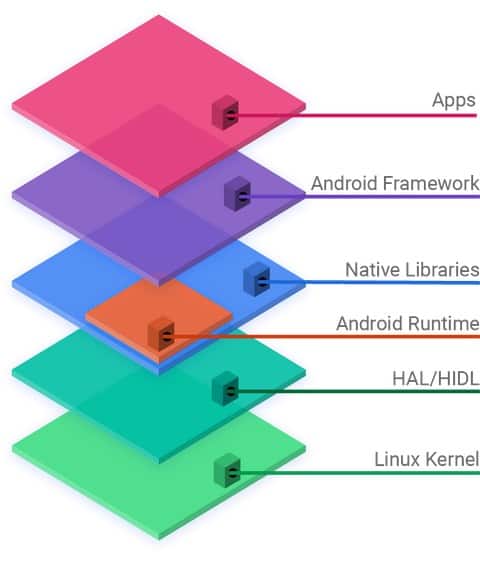
The layers of the Android ecosystem. The Android Open up Source Project licensed nether CC0.
Android devices with Google Mobile Services
The well-nigh common grade of Android on smartphones comes preinstalled with Google Mobile Services (GMS) and Google Play Services. Substantially all of the Android smartphones that you regularly see—from Samsung Galaxies to budget Motorolas—have licenses from Google to preinstall this software.
At a minimum, GMS includes apps such as Google Chrome, YouTube, Google Search and Google Play. Notwithstanding, other popular apps similar Gmail, Google Drive and Google Maps can too be function of the packet.
In most of these smartphones, this combination of Android and GMS is topped off with the device manufacturer's software (unless it's a Google Pixel). The manufacturer volition stop up with a bunch of information, just information technology overlaps a lot with what Google collects.
While manufacturers similar Samsung offer a range of their own information collecting apps, such as Samsung Pay or Bixby, these pale in comparison to Google'southward entire data collection ecosystem.
Considering yous probably employ far more of Google's services than those of your device manufacturer, information technology's reasonable to presume that Google ends up with much more of your information. While nosotros volition focus on Google'due south collection, go along in listen that your manufacturer has access as well.
One of the key differences between them is that your device manufacturer may sell your information, while Google technically doesn't, although it's debatable whether this distinction really matters.
Companies like Samsung and Google don't like to pause down their privacy policies by private products or services, so it'south difficult to tell exactly what each app or service sends back to the visitor servers on its own.
For the sake of simplicity and because these providers are so coy in their privacy policies, we won't go as well specific.
Google'southward information collection
If you're an Android user with Google Mobile Services on your device, one of the best ways to get an idea of what Google is collecting on you is to just ask information technology. You can download the information Google has nerveless on yous through the dashboard of your Google business relationship. This Dashboard also lets yous come across all of your linked services in one area.
Unless y'all are privacy paranoid, the file Google sends you will include a ton of information, roofing things like:
- Location history, including all of the places you accept been
- In-app activities
- Web searches
- Watched videos
- Apps and extensions
- Bookmarks
- Contacts
- Emails
If yous use Google services elsewhere, this data won't give you a perfect representation of what Google collects purely through your telephone. If yous utilise Google Search, Chrome, Maps, or YouTube on your estimator, this data will also exist included. Despite this, it should still exist eye-opening for you to see what the company has been able to collect nearly you.
Considering Google Play Services and the Play Store are integral for downloading and running third-party apps, Google can also access information about other apps. An investigation by The Information discovered that Google had an internal programme known every bit Android Lockbox, which visitor employees used to look up how users engaged with third-party apps.
Android Lockbox accessed the information well-nigh other apps through Google Mobile Services. While the data was anonymous and wasn't personally identifiable, The Verge reported that its sources claim Google has used the information to "keep tabs on rivals to Google's Gmail service or to monitor Facebook and Instagram usage."
A written report from Vanderbilt Academy gives the states a dissimilar type of insight into Google'due south data collection practices. It found that during a 24 hour flow, a stationary Android telephone with only Chrome active in the background communicated location data to Google 340 times. This is for a telephone that isn't even existence used.
In another stage of the experiment, the researchers looked at Android's data collection when most other Google products were deliberately avoided, except for Google Chrome. During a twenty-four hour period of what the study termed "typical utilize", it establish that an Android device collected the user's location approximately 450 times. It made ninety requests per hour, the biggest slice of which were to ad domains.
In total, 11.6MB of data was collected by Google each solar day, most two-thirds of which was carve up betwixt location data and calls to Google's advertizement domains. Remember, this is for people who weren't using Gmail, Maps, YouTube and the many other pop services. Information technology's prophylactic to assume that the amount of data would take been significantly greater if these were also being used.
Still, it'south of import to note that the pure volume of information being sent to Google's servers isn't necessarily a reliable indicator of the amount of personal data, or the sensitivity of such data. Nosotros could exist charitable to Google, just since the company insists on making its privacy policy and configuration settings besides complicated for the average user, we won't gauge you if yous assume the worst.
The study likewise found that Android devices were sending through MAC addresses, IMEI numbers and serial numbers alongside users' Gmail IDs. It also claimed that Google had the potential to deanonymize data through its various streams of information drove.
Google's data drove on iPhones
If you accept an iPhone, but still use services like Chrome, YouTube, Google Maps or Gmail on it, Google will nonetheless get data through these apps. Y'all may want to bank check out what data Google manages to collect through your iPhone using the steps listed in the previous section.
The same Vanderbilt Academy study constitute that an idle iPhone would send 0.76MB per twenty-four hour period to Google servers, averaging only under one asking per 60 minutes. These requests were commonly advertising-related. When the iPhone was used in a typical way, information technology was establish to send i.4MB to Apple each day, with about xviii requests per hr.
While this phase of the study involved deliberately avoiding well-nigh Google products (except Chrome), it does evidence a significant divergence between the two company'due south practices. In that location were no advertizement-related calls to Apple's servers, and it sent less than 1/xvi of the amount of location data that Android phones sent to Google servers.
However, the use of Chrome and Google's extensive ad infrastructure beyond the spider web meant that iPhones were nevertheless sending about 50 requests per hour to Google servers, totaling almost 6MB. Almost all of this data involved calls to ad domains.
Google has fifty-fifty paid Apple billions to be the default search engine on Safari. While Apple tends to have a much amend privacy reputation, information technology's hard to deny that it has also been complicit in the information collection of its users.
Apple tree & iOS
If you lot want to have a look at the data Apple collects on you, you lot can download information technology past logging in at privacy.apple.com. Follow the prompts under the Obtain a copy of your data section to get sent a copy.
While this may include data Apple tree has acquired outside of your device, it will give y'all decent insight into what types of data the company collects. The data can include things similar your:
- Apple tree ID account information and login records.
- Call history.
- Data stored on iCloud.
- Browsing history and purchase records from iTunes, Apple Books and the App Shop.
- Buy records from Apple retail stores.
- Information from Apple tree apps such as Game Center, Apple Music, iCloud and the Wellness app.
Compared to Google's data collection, Apple'southward practices seem relatively benign. The company tin can afford to be, because a pregnant portion of its income comes from paid hardware, every bit opposed to Google's business organization model of mostly ad-supported gratis software.
Apple tree hasn't been allowed to bugs or privacy scandals, but it does seem to be making privacy more of a focus in its products. A good example is the release of iOS 14, which included privacy-enhancing features such as:
- An indicator of when apps are accessing the photographic camera or microphone.
- Granular configuration options for location and photo permissions.
- Randomized MAC addresses.
- Notifications if apps are accessing clipboard information.
- A feature that will crave apps to inquire for permission to rails you across websites and other apps, due next year.
While Apple devices may collect less data, at that place is still a lot that the company can meliorate on.
Apps
We accept partially talked nigh the information drove of apps from Google, Apple and device manufacturers, considering the lines between the types of data collection are so murky. However, there is yet much more app-related data collection to comprehend.
Officially, apps are downloaded from the App Store or Google Play. These are generally vetted by their respective owners, with Apple having a better record for keeping the worst apps out. However many mutual apps will still suck up tremendous amounts of information. Remember the one-time adage that has go a platitude in our age of complimentary software: If yous aren't paying for the production, then you are the production.
Apps can access whatever data to which they've been granted permission. These days, you lot volition observe permissions when yous endeavour out new functions on your apps. They will enquire for permission to access things like your microphone, camera, location, storage and much more. Most users will just accept, because they either don't care, don't understand, or simply don't accept time.
Virtually apps don't merely go on their information to themselves. There's a complex arrangement of data sharing that includes advertisers and many other third parties, including major tech companies like Facebook and Google.
Apps are sometimes able to admission information fifty-fifty though y'all may accept turned off what seems like the relevant permission. Malicious apps can besides subvert the permission system.
In general, if you care about your privacy y'all should exist denying permission to anything that won't suspension the app's cadre functionality. If an app requires permissions that don't make sense, let's say a note-taking app that inexplicably wants access to your camera—it's a good sign to look for an alternative.
Apps can track you through the resettable advertisement ID that you are issued by either Apple tree or Google. While these are supposed to be anonymous, it is possible to be deanonymized through data from other streams.
Web browser
1 of the biggest dangers to privacy is your browsing app, your gateway to the internet. Your browser will exist able to admission whatever data or resources you have given it permission to access. This can include sensitive things such as your location data, which tin exist sent back to company servers constantly throughout the day.
The well-nigh obvious data is your spider web activity. Browsers can track and shop the details of the sites y'all visit from day-to-day. Just think about the power of this information—if you are starting to feel unwell, peradventure you would look up the symptoms through your browser. While some people may non intendance, there are certainly some intimate medical problems that almost of u.s. would not desire tech companies to know nearly.
Our browsing history will also oft indicate our political leanings, based on the news sites we visit and the articles we view. Of course, your interests volition also be revealed, considering you probably expect up information related to your hobbies all of the time. Searching local restaurants could evidence where you alive. Reviews for certain purchases could reveal data about your income. And this is just the first.
If you lot apply a search engine that is developed by a company separate to your browser, then you will exist sending your search queries and clicks to the search provider as well as your browser.
On pinnacle of this, the websites you visit tin can track you besides. Through browser fingerprinting, they can tell what device you use, your configuration, and they may exist able to discern your identity. The advertising IDs from Google and Apple can too help them track you lot across the web. Logging into your accounts can leave behind footprints as you browse the internet.
Unfortunately, in that location's even more. Advertisers, ad networks and other 3rd parties can also runway you lot through the likes of JavaScript trackers and cookies. This research paper provides a deep dive into just how pervasive these practices are.
While you are still tracked excessively through your desktop browser, the data drove through mobile browsers is even more worrying because of how much access mobile browsers can have.
Social media & messaging apps
We accept already discussed how apps can access whatever you give them permission to. Considering that social media and messaging apps tend to enquire for such a broad diverseness of permissions, it'due south a pretty safe bet to assume the worst nearly their data collection practices.
The likes of Facebook, Instagram, Twitter, and even the relatively immature TikTok accept all been involved in countless privacy scandals. The majority of the activeness on these platforms is done through their apps, so it's too a reasonable assumption that this is where most of the data collection occurs.
Facebook tracks people's locations through the app, your geotagged Tweet history prior to 2015 was available in the API, Instagram tracks a variety of location-related information, while TikTok gets location data through your SIM card, IP address and GPS. These apps take the power to know where you lot alive, where you work, when y'all go out, and who y'all spend time with.
Of course, they all get whatever data y'all give them and mail. They also end up with all of the information that your friends post about you as well. They get the contents of your letters too, unless yous employ terminate-to-end encryption, such every bit in WhatsApp. Even when this is the example, these companies tin can still access the metadata, including who the recipient was, and when the message was sent.
Social media apps may accept access to your contacts. Facebook used to have a problems that even fabricated it possible for 3rd-political party apps to access photos you hadn't even posted.
If you lot have given any of these platforms your telephone number for ii-factor authentication, it may accept even been used for advertising. Both Facebook and Twitter have been fined for this in the past.
Facebook has already settled an Illinois lawsuit regarding its collection of users' biometric information. The criminal offence was so serious that it cost the company $650 million. Instagram and TikTok are now being sued for the same practice.
Information technology's not applied to cover all of the different ways that these social media platforms collect your information. Nonetheless, yous can check information technology out for yourself. You can access your Facebook information by going to the app, clicking on the menu push button in the corner, then Settings and Privacy>Settings>Your Facebook Information>Access Your Information>Download Your Data.
In the Instagram app, it's the menu, then Settings > Security > Data and History > Download Data. On Twitter, y'all need to log in via the website, click More > Settings and privacy > Select the correct Business relationship under Settings > Then Click on Your Twitter data under Data and permissions.
Through the TikTok app, become to your contour, then click on the ellipses at the elevation right. Click Privacy and safety > Personalization and information > Download TikTok data.
While you may exist shocked by just how much data these companies have on you, at least once you lot are enlightened, yous tin begin taking the steps to minimize their rampant data collection practices.
Virtual assistants
The likes of Siri, Bixby and Google Assistant go a lot of flak from smartphone users. If you talk to your friends or colleagues, you may find that many of them believe these virtual administration are listening to them, fifty-fifty when the trigger phrase hasn't been spoken. They may tell you a story about how they were talking nearly some unusual product, and then the next time they checked their phone, they saw an ad for information technology. What else could it exist, except for their phone spying on their conversation?
While this view is tremendously mutual, in that location is no evidence to back it upwardly as a widespread do. There are plenty of instances where these virtual administration made recordings when they shouldn't have, but the most probable reason behind them is that these are but caused by bugs or malfunctions, such every bit the mishearing of a trigger phrase.
This is because it'southward piece of cake for security researchers to await at what data these apps are sending back to the servers. Large amounts of audio vocalization recordings would not go unnoticed, and we would have plenty of evidence by now.
The about likely explanation for these experiences is a combination of coincidence, plus insights gathered from all of the other information that these companies already accept on you. Given the many other streams of data collection that we have discussed so far, plus the circuitous algorithms, these platforms tin make surprisingly accurate predictions.
This isn't to say that virtual assistant apps don't collect your data. They certainly exercise, yet, the data they collect is more akin to that of your search engine keeping track of your queries, every bit opposed to some all-listening, all-knowing deity.
Other apps
If we go through every type of app in item, this article volition quickly become repetitive. Instead, yous should exist aware that your apps have access to everything you requite them permission to, that this can include more data than you may expect, and that it can exist shared with third parties like advertisers.
Broadly speaking, apps in these categories will collect the following types of information every bit well:
- Amusement apps similar YouTube, Netflix and Spotify continue track of what you lot picket or listen to, for how long you play information technology, and can make sophisticated profiles and recommendations based on your habits.
- Dating apps like Tinder and Bumble hoover up tremendous amounts of data, including your profile, location, pictures, and whatsoever steamy messages you lot might transport to potential matches.
- Map applications like Google Maps can track your location through GPS, cell signal and wifi. The latter two still function when the location setting is turned off on a user'southward device. They can gather information about your management, speed, presumed mode of transport and more. Over time, this can build upwardly a contour of your daily activities.
- E-mail applications similar Gmail store all of your sent and received letters, simply at to the lowest degree in Gmail's case, the content is no longer scanned like information technology used to be. Metadata, which includes who yous are talking to and when, is also nerveless. Gmail can also track your purchases if the receipts are sent through your business relationship.
- Gaming appsouthward can also suck up immense amounts of data and have a trend to ask for extensive permissions. Angry Birds was even named by the Snowden documents as one of the "leaky" apps that the NSA used to admission personal information.
- Finance apps like Acorn and PayPal'south Venmo may be handy, merely 80 percent of users don't realize that these apps store their banking credentials equally part of the service they provide.
- Fettle apps similar Strava can exist great for keeping track of your practice regimen, but it makes your activities public by default. Sharing data such as where you run or bike could requite away where you live.
- Camera apps similar Beauty Plus were establish by Tendency Micro to exist turning on cameras without user permission and spreading malware.
- Rideshare apps similar Uber obviously collect data near your trips and analyze them thoroughly. Simply the geolocation and demand of riders likewise affects Uber's surge pricing model.
- Utility apps like organisation cleaners, antivirus and performance boosters oftentimes host malware and collect excessive amounts of information.
Other types of apps that nosotros haven't covered also collect all kinds of data. Equally we have discussed, even popular apps can have invasive information collection policies. Nevertheless, y'all should exist wary of lesser-known apps and those that come from developers with poor reputations, because at best these often soak up large amounts of information. At worst, they may be spyware or other types of malware.
Hackers
We've covered the bulk of the means that device manufacturers, operating systems, apps, advertisers and other tertiary parties tin track you when yous use your smartphone. While some of these may mistiness legal and ethical boundaries, malicious hackers volition jump straight over the line.
Some are motivated by fiscal gain, often stealing information to sell, or by directly gaining access to banking concern accounts. Others may be focused on high-value targets such as business executives, government officials or activists. They may be interested in intercepting your communications or stealing sensitive and valuable information.
Less-sophisticated cybercriminals will probably focus on the offset tactic, while groups with more resources or links to nation-states may pursue the second line of assail.
Hackers can access your data through a variety of unlike techniques. Some of the nigh renowned include:
- Man-in-the-middle attacks – These allow threat actors to insert themselves into your connectedness, accessing the data that goes in and out of your device. I of the most mutual MITM attacks involves cybercriminals setting upwards seemingly legitimate hotspots. They trick users into connecting and then intercept all of the unprotected data that passes through.
- Malicious applications – Threat actors place malware into apps and try to distribute them through app stores. These malicious apps can then spy on users who accept been duped into downloading them, track their data and introduce other software into the surround. Apps that seem benign now can introduce malware in a later update.
- Sophisticated malware such as Pegasus – Through phishing and a serial of avant-garde exploits, this type of sophisticated malware can essentially take over the victim's smartphone.
If hackers manage to put spyware on your device or gain root admission, they essentially have free reign over any data that goes in or out of the device. They may be able to discover out your passwords and access your accounts, remotely activate your camera and microphone, and even access the content from apps that are more often than not seen as secure, such as Signal.
If your smartphone gets taken over by hackers, you demand to assume that everything on the device could autumn into their easily. Fifty-fifty if you get a new device, they may be able to easily proceeds access through other systems and accounts that they may have already compromised.
The government
The government is another major political party that may exist able to track yous. The specifics will vary from jurisdiction to jurisdiction, with some offering far more than protection, transparency and accountability than others.
The types of data drove will vary. In many countries, the authorities will need a warrant to access your smartphone records from your network provider or one of the many tech companies who have information on yous. The US has a variety of secret court orders, and even some that don't involve whatever judicial oversight. Authoritarian countries and those without due process will probable face like government overreach.
These types of warrants and orders may give the government access to your past records, or let them to put you under surveillance. In that location have also been mass surveillance programs like the NSA's PRISM and MUSCULAR. While the outrage after the Snowden revelations seems to have scaled such programs back, nosotros can't know what governments are currently capable of. After all, the NSA'due south powers were kept surreptitious for many years.
At a local level, law enforcement may likewise deploy stingrays, which can force all nearby mobile devices to connect through them. These can identify each device in a given area, runway individuals and intercept data.
In addition to these wider surveillance tools, governments may also target individuals. The to a higher place-mentioned Pegasus malware is often used by governments to get intimate access into the data of journalists, activists and criminals.
How your phone tin track you even when turned off
When powered off, smartphones are supposed to exist disconnected from cell towers, wifi networks, GPS and Bluetooth. However, highly motivated adversaries may be able to continue tracking them when they are off—or at least when they announced to exist off.
The FBI listens in to the mafia
While the details are sketchy, the get-go revelations that phones could be contradistinct to spy even when turned off came in 2006. The news broke out following an FBI investigation into members of a New York organized crime family.
What we know for sure comes from the judge'south opinion. He wrote that the eavesdropping technique "functioned whether the phone was powered on or off". Yet, we don't know exactly how it was accomplished.
The FBI may take gained physical access to the phone and added a separate hardware listening bug to it. If this is the case, then the spying could merely be accomplished due to the additional device.
An alternative explanation is that the spying was achieved through software, which may have been planted through a physical or network connection to the device. The CNET article speculated that this was more likely, because the bombardment of a hardware issues would not take lasted for the whole yr of the investigation.
The article also referenced courtroom documents that stated the bug works "anywhere within the United States" and speculated that this would make it outside of the range of an FBI agent with a radio receiver. This likewise implies that software was the more likely culprit.
The NSA vs Al-Qaeda
One of the next major news stories showing that phones could exist tracked even when turned off was published past the Washington Postal service in 2013. The technique, dubbed, "The Detect" gave the NSA thousands of new targets, and was used against an Al-Qaeda sponsored insurgency in Republic of iraq.
The Mail did not report on how it worked, but Slate speculated that the devices were infected with malware that could force them to emit signals, unless the battery was taken out. Nether normal circumstances, a phone would stop communicating with cell towers when turned off.
Slate's assumptions seem far more likely than whatsoever kind of hardware rig, seeing every bit the Postal service implied that the technique allowed the NSA to find the devices, and it would not be applied to physically find the Al-Qaeda phones and insert thousands of listening bugs.
How can phones rails you lot even when they are turned off?
The kickoff possibility involves the attacker planting a hardware spying device on your phone. This would require concrete access to your phone for a significant amount of time, which makes these types of attacks unlikely unless you are facing a highly capable threat actor. If your adversary is willing to go to these lengths, it is incredibly difficult for you lot to maintain your security against them.
If this happened to you and you lot knew what you were looking for, it may exist possible to run into the listening device within the phone if yous open it upwards. Notwithstanding, it is far more likely that your assaulter would pursue the easier alternative, through and use malware to spy on yous instead.
Under this approach, an attacker could infect your telephone over the internet without ever having to go about it. If they did so and and then you tried to switch the phone off, it'south possible for the phone to simulate the shutdown process, while nonetheless staying active and spying on yous.
Notation that even when phones betoken that they are out of battery, they aren't completely drained. You tin tell because virtually phones will display some type of animation to show you that your battery is expressionless. This would not be possible if it was 100 percent empty. The fact that a minor amount of battery remains leaves the possibility open for a phone to transmit signals nether certain circumstances.
Can your phone track you when the location is switched off?
Near of us probably don't accept to worry too much about the higher up scenarios. Still, there is a common myth that leads people into a fake sense of security.
Many people assume—reasonably so—that they volition no longer exist physically tracked when they turn off the location setting on their phones. Unfortunately, this is not a instance. Switching this setting off does stop y'all from being tracked by GPS, but that's just one of the ways that your phone's location tin can be recorded:
Network signals
Your cellphone frequently communicates with your network provider'due south closest base stations, even when yous aren't making calls. This gives it a crude idea of where your device is.
The force of your device's signal, whether it is stronger or weaker, gives your provider even more information virtually how far away your cell phone is from a tower. When the betoken from multiple towers is combined, information technology's possible to narrow downwardly the location fifty-fifty further.
The accuracy varies according to the technique used and the density of base stations in an area. In some urban areas, it's possible to pinpoint a device's location to within fifty to 100 meters with Advanced Forwards-Link Trilateration. It can be significantly less authentic in rural regions, due to the lower concentration of cell towers.
Network providers often hand over this data to the government, and have fifty-fifty been known to sell it every bit well. When this data was placed on the market, a range of people could purchase information technology with limited oversight, granting them cognition of a phone's location within a few hundred meters.
It's not just your network provider who has access to this type of location information. Google was defenseless collecting data near the closest towers from phones that didn't fifty-fifty take SIM cards. While the visitor promised to terminate the do, the immense complication of our communication systems and the unscrupulous behavior from the companies involved shows just how difficult it is to prevent ourselves from being tracked.
Wifi
But as your network provider tin can gauge your location based on where you are in relation to its towers, wifi access points too give away where you are. If wifi is turned on, your operating system can periodically ship the wifi access point's service set identifier (SSID) and media access control (MAC) address to companies like Google. This gives them a rough thought of your location.
Free wifi providers are also renowned for invasive tracking, because they can link these identifiers to whatever personal information you provide when you sign in to the service.
When wifi is turned on, phones send out data when searching for admission to points to connect to. They don't even have to connect for this data to be sent out to access points, or to whatever hackers that may be intercepting this data besides.
Bluetooth
Bluetooth doesn't keep track of the physical location in space similar GPS does, simply it does record interactions with other Bluetooth devices. Withal, if your telephone'due south Bluetooth is recognized by a store's Bluetooth beacon—or someone else' device whose location was known—this infers that your device was in the aforementioned identify at that particular fourth dimension.
This makes it possible to track your device through Bluetooth. We see this in the promotions stores send to their customers via push notifications when their Bluetooth comes within range. Countries all over the world are also using Bluetooth interactions to runway the spread of coronavirus.
While y'all may have thought that turning off your Bluetooth would completely finish this from happening, information technology isn't e'er the case. In 2018, Quartz found that Android devices could still be tracked through Bluetooth beacons while Bluetooth was turned off. Nonetheless, this was only possible if the device had the app for a nearby store installed.
Other possible tracking mechanisms
If all of these techniques haven't scared yous enough, a paper published past the Establish of Electrical and Electronics Engineers may do the flim-flam. A team of academics created an experimental app that could rail users through other means, such as the device's timezone, its gyroscope, accelerometer, barometer and magnetometer.
Co-ordinate to the paper, these sensors can exist accessed without a user'due south permission, and could be used to 'accurately gauge the user'due south location. Although we have no confirmations that whatever companies use similar techniques to rails users, this proof-of-concept of fifty-fifty more ways to track us should exist worrying enough.
How can you lot fight mobile data tracking?
The ideal solution is probably to find the nearest river and heft your smartphone into its murky depths. Most smartphones are absolutely terrible for your privacy. Those that aren't, such every bit the Librem five, are by and large lacking in features or functionality. It comes downwards to the way that smartphone ecosystems are designed, they're just bad for privacy, far worse than computers.
But few of us are going to give up the convenience and connection that our smartphones offer us and go off and live in the woods. For most of us, smartphones accept become essential parts of our professional person and social lives, and completely giving them upward would be immensely challenging.
So what pick do we have?
It'south probably going to accept a long time earlier about of the world has any reasonable regulatory protections against the privacy invasions of smartphones, so your only realistic option is to take your own steps toward preserving your privacy.
Hither's how to fight mobile information tracking:
- Minimize your smartphone utilise
- Use a privacy-focused phone or operating system
- Utilize privacy-focused apps
- Limit advert tracking and reset your advertising ID
- Use a VPN
- Lock down the settings on all of your accounts
We'll go into more detail on each of these precautions below.
1. Minimize your smartphone use
To get-go with, avoid smartphones as much as realistically possible. If yous tin get past with just a dumbphone and a figurer, do that. Make people call or text you for emergencies, and deal with everything else when you are at your computer.
If a smartphone is a must, go out it at habitation when you don't demand information technology. Keep the number of apps on it to a minimum, and limit the corporeality of data that it has access to. If you lot must have access to social media on your phone, endeavour to access the sites through your mobile browser rather than having the apps installed on your device.
For any apps that you do have, limit the permissions for what they can admission to the blank minimum. Keeping information, wifi, Bluetooth and location switched off when yous aren't using them may also help.
two. Utilize a privacy-focused phone or operating system
Phones such as the Librem five are designed with privacy in mind, and so they are a expert choice if you really want to limit data drove. However, these are relatively pocket-sized companies with neither the research and development budgets, nor the economies of calibration that their mainstream rivals have. While these privacy-focused companies are mostly doing good work, these limitations tend to result in phones that are less sleek, limited in features and more than expensive than their competitors.
Another good choice is to get a compatible Android phone and set it up with a privacy-focused operating system like LineageOS, instead of Android with Google Mobile Services. This will require a lot more endeavor to gear up than a normal phone, and is probably simply a suitable choice for those who are more technical.
Realistically, the vast majority of people aren't going to notice the to a higher place two options suitable, so the next best pick is an iPhone. If you are a diehard Android supporter or simply find iPhones too expensive, you can still limit the information collection through your Android device by following the rest of these steps.
iii. Apply privacy-focused apps
The skillful news it that at that place are a number of apps that protect your privacy much more than the ones you may exist used to:
- Utilize Firefox or the Tor browser instead of Google Chrome or Safari. Annotation that in that location is no official Tor browser on iOS, but the Tor Project does encourage Onion Browser. Use DuckDuckGo or Startpage equally your search engine. If you use Firefox as your browser, you lot can lock it downwards even further with add-ons like uBlock Origin, HTTPS Everywhere, NoScript, and Decentraleyes.
- Use Bespeak as your messaging app. Failing that, WhatsApp or Telegram are better than Facebook Messenger and Instagram.
- Use a maps tool like MAPS.ME instead of Google Maps.
- Use NewPipe instead of YouTube.
In that location are many more apps that offer better privacy options than those that you may exist accustomed to. Privacytools.io and PRISM BREAK both take a number of good recommendations. Alternatively, you may want to look into some of the free and open-source software (FOSS) alternatives.
4. Limit advertizement tracking and reset your advertizement ID
On Android, you can limit ad tracking past going into Settings, so selecting Google, then clicking on Ads. From this menu, you can click to Reset your advertising ID, and slide the toggle for Opt out of Ads Personalization.
On iOS, yous can practice the same past going to Settings, and then Privacy, to Advertizement, and and so clicking on Limit Advert Tracking. There is likewise an pick to Reset your advertising identifier.
5. Employ a VPN
VPNs can help to hide your identity by obscuring where your traffic originates from. All the same, you still accept to be conscientious about how you utilize them. If your VPN gets cutting off and at that place is no killswitch to stop the connection, your IP address might be revealed. While VPNs are cracking for protecting your data from your Internet access provider, they can't stop you being identified by websites through browser fingerprinting. Logging in and inbound your personal details will also requite you away.
Employ a reputable company that ideally takes no logs, such as one from our all-time VPNs listing. Exist wary of free VPNs, because they may sell your data or include malware.
vi. Lock down the settings on all of your accounts
In response to Europe's landmark Full general Data Protection Regulation (GDPR) introduced in 2018, companies began introducing more than granular privacy settings that gave users back at to the lowest degree some command of their information. All of the tech giants have these, including Facebook, Google, Amazon, Twitter, Microsoft, and the many other companies that shop your information.
While these tools can be confusing and don't let you to limit all types of data collection, they tin can help to significantly cut back on the amount of data that these companies go along on you. They are usually found in the privacy settings of the respective app or website.
The hereafter of smartphone tracking
All of the to a higher place recommendations are but a get-go. They won't make your smartphone invisible to the exterior world, merely they volition significantly cut back on the corporeality of data nerveless from your device.
Unless nosotros are willing to go to the extreme lengths of completely giving up our smartphones or dedicating meaning amounts of our time to OpSec, we are going to have to have that we volition exist tracked to some degree well into the futurity.
Due to the complexity of these systems, and the fact that near of u.s.a. simply don't have the time to sympathise them and navigate them effectively, information technology seems similar the only possible savior will exist regulation. We demand laws that simplify these systems, make everything easier to empathise, offer meaningful ways to opt-out, ban the almost egregious forms of tracking and severely penalize offenders.
At the moment, such laws seem like pipe dreams for the majority of the world. For now, you volition accept to take things into your own hands if you want to limit the tracking every bit much as possible.
Indoor location services by Intel Free Press licensed under CC0 .
See likewise:
- How to end Google, Microsoft and Apple tracking y'all
- Best VPNs to end your Isp tracking your activities
- Ultrasonic tracking apps
- How to stop browser tracking

What App Can Be Used To Talk And Not Be Tracked By Your Service Provider,
Source: https://www.comparitech.com/blog/vpn-privacy/stop-mobile-phone-tracking/
Posted by: glenncaushre.blogspot.com
0 Response to "What App Can Be Used To Talk And Not Be Tracked By Your Service Provider"
Post a Comment